Saturday, 15 October 2022

THE JOURNEY

Mrinmoyee to Chinmoyee
(From Clay Idol to Supreme Consciousness)


The first day we tried entering Kumartuli, we were stopped by the barricade put up by Kolkata Police stating that only vehicles picking up idols were to be allowed.  It was Chaturthi and only two days were left for the auspicious day of Sashthi which marked the first of the five-day long festivities. We returned disheartened. On the next day, we reached early in the morning to find a parking for our car on Rabindra Sarani in Baghbazar in North Kolkata, and then slowly inched our way on foot into one of the many narrow lanes and by-lanes of Kumartuli . Kumar-tuli or Kumor-tully or the potters’ colony is where the famed artisans or idol makers of Kolkata reside and work.  Months of hard work go into creating the magnificent clay idols sculpted to perfection by the artists and sculptors of Kumartuli who take the orders not only from the innumerable Durga Puja committees in Bengal but even from various cities around the globe. They even travel to distant lands to make these images on site.


As we walked down this narrow, crowded lane, we saw the master craftsmen giving their final touches with their paint brushes to the last few idols of Ma Durga and her children, Lakshmi, Saraswati, Karthika and Ganesha. These were the smaller ones meant for homes and residential complexes since the bigger idols had already taken their positions in the sanctum -sanctorum of the various pandals of Kolkata and the neighbouring suburbs. For other distant places, they would have been shipped long ago. Most of the idol makers were busy working in their workshops on massive idols or pratimas of Ma Kali, who is worshipped on Deepawali night in Bengal, and also on the much smaller murtis of Ma Lakshmi , who is worshipped on the Kojagori Purnima ( full moon ) night that comes soon after the visarjan or immersion of Ma Durga. All around us we saw people carrying or carting away the idols of the goddesses in hand-pulled carts to small tempos or pick- up trucks waiting on the main road. If the distance was short then four or five labourers simply carried them on their heads. Utmost care had to be taken during transit since the idols were all hand-crafted from clay and had to be protected from damage and even, untimely, rain. Shops glittering with chandmalas, chalchitras and other items of decoration adorned both sides of the narrow gully. The idol makers went about their work unaffected and unconcerned with the likes of us who were busy trying to capture the sounds and sights of these streets in their cameras and mobile phones. As we carefully maneuvered our way further into the lane we found a bust of the poet Nazrul Islam lying in a corner or had the towering figure of Swami Vivekananda looking down on us from a pedestal. The statues, busts and figures of man and god, angels and demons , animals and apsaras are scattered in every nook and corner of Kumartuli- all created by the deft fingers of these unknown and unsung master sculptors.


The Kumartuli Sorbojonin Durgotsav this year paid its greatest tribute to the shilpis or master craftsmen and artists of this place belonging to the Pal community, who have for generations created the idols of Durga and her family, by having their names engraved, printed, painted, sculpted on every inch of the pandal ,the makeshift home of the goddess for those few days. As we entered the puja pandal and admired the massive pratimas or idols we could not but read the names of Soumen Pal, Nitai Pal, Paresh Chandra Pal, Jitendranath Pal, Kanu Pal, Shyma Prasad Pal, Mintu Pal , Moni Pal, Ramkanta Pal, Kartik Chandra Pal and so many others as we bowed our heads in obeisance.

Kumartuli Sarbojanin Durgotsav

To make the idol of Ma Durga, clay from the river Hoogly, a tributary of the Ganga, is obtained by the potters or idol makers of Kumartuli from river bank. It is not just the clay or mrittika (mati) from the holy river that goes into it but also cow dung, cow urine and, most importantly, soil from outside the brothels or nishidhdho palli (forbidden locality). This soil, called punya mati or pure soil, cannot be just collected from outside the brothel but the idol-maker has to ask for it and receive it from the hands of the sex-worker. This has been the tradition and is followed till date. The rationale or reasoning behind it could be one of inclusivity -all are included and no one is an outcast- and that the festival is all about equality and respect, brotherhood and compassion. The second explanation which I read about is that the soil outside the brothel is blessed as it is believed that people who visit the place leave all their virtues and piety behind before entering through its door. So the soil outside absorbs all virtues and is blessed or is ‘punya mati’.  The third explanation is in the tradition of Shaktism- worship of Shakti - in which Navakanyas  or the nine forms of women, depicting the various manifestations of the Divine Feminine, are worshipped during the ritual of  Durga Puja, namely Nati (dancer), Vaishya (sex worker),   Rajiki (washerwoman), Gopala (milkmaid), Napita (barber),Malakara (gardener), Shudra (backward class woman), Brahmani (upper class woman) and Kapalini ( skull bearing worshipper of Lord Shiva). Whatever be it, the ritual is still followed by the idol makers.


The job of these idol makers is a long and tedious one, stretching into months, which they have been doing for hundreds of years through several generations. The art and skill are passed on from one generation to the other. It also involves a lot of responsibility since they can make no mistake in creating the gods and they do so with full devotion. First, the
kathamo or wooden frame , is made from bamboo and wood. This begins on the day of Ratha-yatra in the month of July. The body or the torso is made from specially cut straw or hay, after the harvest of rice, and limbs take shape as the straw is bound by ropes keeping the proportion of the human body in mind. Then the clay is mixed with water, strained and kneaded to the right consistency, and mixed with rice husk and jute fluff, before being plastered over the straw. When the first layer dries, the cracks are smoothened and further layers of clay are applied before sculpting the figures to perfection. Every muscle, sinew, curve is contoured by the hands of these magicians from clay. Faces of the gods and goddesses, made of plaster of paris, are separately cast in moulds or individually handcrafted with clay and attached to the figures. This is followed by spray painting, colouring every feature, crease and arch with the deft strokes of the paintbrush.Then comes the varnishing, polishing and powder colouring to give the deities the human forms with divine aura. Finally, the hair, generally made of jute fibre, is fixed, once the clothes, embellishments and ornaments have been arranged. I gathered from one of the organizers of a community puja that they actually select and buy the saris and dhotis for Ma Durga and her family and hand them over to the idol makers for draping and, in some instances, gold jewellery is used. These days artistic innovations and sustainability are driving many artists to make idols from other materials ranging from ashthadhatu to waste products, environment friendly organic fibres, even chalk and wooden ice-cream sticks  have been used, but for the actual puja small clay idols on a ek-chala frame are still made by these idol makers from Kumartuli , which are placed at the feet of those massive artistic creations, for the priest and devotees to carry out all the rituals.

It is on Mahalaya, which falls a week before Durga Puja, that the ritual of chakshu daan or painting of the eyes on the trinayani devi is done by the senior idol makers who specialize in this. Mahalaya also marks the end of Pitri-paksha (when prayers are offered to our ancestors) and the beginning of Devi-paksha. We wake up on this day to chants of Chandipath, agomani  songs welcoming the goddess and the beat of dhaak .It is believed that on this day Ma Durga leaves her abode in Mount Kailasha, her husband Shiva’s home, and comes down to her maternal home on earth with her four children. She chooses any one of the four vahans– palanquin, boat, horse or elephant – to transport her.

It is through the various rituals of the next few days that the clay idol or mrinmoyee becomes the chinmoyee or the Divine Goddess who is omnipotent, omniscient and omnipresent. Sashthi, the sixth day of Navaratri , begins with the invocation or bodhon and other rituals to welcome the deity. Since the ritual of Durga puja also has its origins in the worship of dharitri or Mother Earth, the source of all creation, the worship of nature or the agrarian touch is still continued in the ritual of navapatrika snan (worship of nine leaves) on Saptami, the  seventh day . This is also the day when the ritual of pran pratishtha or giving life to the idol is performed. On Ashtami , the Kumari  Puja takes place in which the goddess is worshipped in the form of a young girl child. The Sandhi  puja  performed in the evening marks the last 24 minutes of Ashtami and first 24 minutes of Navami. During this time the deity is worshipped in her Chamunda form, the slayer of demons or the evil in us. 108 lotuses are offered and 108 lamps are lit. Dashami, or the tenth day, brings an end to all the festivities as it marks the day of visarjan or immersion which begins with Devi baran or bidding adieu to the Mother. Every woman worships the goddess in the form of a woman and mother and applies sindoor or vermillion on her forehead and feet while praying for the wellbeing of her family.  All devotees can, if they wish, offer puja in the form of pushpanjali or offering of flowers while chanting the mantra with the priest on all the four days. On the tenth day the images are immersed in the river from where the clay came. Immersion of the idol in the water is symbolic of Ma Durga returning to her cosmic world. The lamp burning in the desolate podium of every puja mandap is the hope she leaves behind of her returning again. As the dhaaks or drums beat, the cymbals chime, the fumes and aroma from the incense and dhunuchis fill the air,  devotees standing before the goddess can see the changes in her facial expressions beginning with joy of homecoming on the first day to that of sadness and pain of leaving on the final day.  Perhaps the credit for this can only go to those hands which create such masterpieces blending the divine in the human and the human in the divine.

From Female Cult to Mother Goddess: History and tradition

A visit to an exhibition at the Indian Museum, Kolkata on Durga: The Divine Power was very enlightening as it traced the evolution of the tradition of worship of the female principles, representing fertility, motherhood and creation as the embodiment of earth, into the worship of Devi Durga in the form of matrirupena (mother goddess) and shaktirupena (goddess of strength and justice)as a personification of womanhood and salvation for humanity. The exhibition also highlighted that the tradition of worshipping the feminine form is traceable to the Neolithic period which continued into the early agrarian communities. The Harappan Civilization, like the other great civilizations of Assyrians, Babylonians and Egyptians, have also yielded a large cache of terracotta figurines as evidence of the worship of Mother Cult. As time passed and history progressed, the tradition of worshipping fertility deities evolved into the form of divine mother goddesses. Since the beginning of the Christian era, Devi Durga was being worshipped as a demon slayer. One of the earliest sculptural representations of the Devi is from the sites of Bhita and Mathura in which she is seen in a typical Kushan era style dhoti, girdle and carrying a trishul or trident. She is also seen as Simhavahini devi in gold coins of the Gupta era.  The fifth century epic tale of triumph of wisdom over ignorance described in the Devimahatmyam of the Markandeya Purana narrates how Devi Durga was created as a warrior goddess to fight the demon Mahishasura. After being granted a boon by Brahma that neither God nor man would be able to defeat him, Mahishasura invades the Gods and unleashes terror on heaven, earth and the netherworld. The Gods then create Durga who, after a fierce battle that rages for days, finally vanquishes the demon on the tenth day and becomes Mahishashuramardini (Slayer of Demon).

Mahishasuramardini at Indian Museum, Kolkata

Over the years, Bengal has become the cultural heart of the national and global celebration of Durga Puja. The earliest mention of such public celebration of Durga Puja is in the 14th Century CE text, Durgabhaktitarangini by  the Maithili poet Vidyapati. Since medieval period Durga puja has been held within the private precincts of wealthy and influential families. The Sabarna Roy Choudhury family has been celebrating Durga Puja since 1610 in their ancestral home in Barisha.  Raja Nabakrishna Deb started Durga Puja in Sobhabazar Rajbari since 1757. Rani Rashmoni also celebrated Durga Puja at her residence in Kolkata. The descendants of these families still continue with the tradition. As time passed, the private celebrations of the elites were taken over by the masses as Baroyaari Puja or community celebrations and with broader participation came to be known as Sorbojanin Pujas (including all in the community). As early as 1790, twelve residents of Gooptipara, Hoogly, organized the first Baro-yaari puja by collaborating and collecting contributions from local residents. It is believed that Raja Harinath of Cossimbazar brought the Baroyaari puja to Kolkata in 1832.

Puja at Rani Rashmoni Bhawan

In December 2021 UNESCO listed the Durga Pujo of Kolkata as an Intangible Cultural Heritage of Humanity. The inscription states, “Durga Puja is seen as the best instance of the public performance of religion and art, and as a thriving ground for collaborative artists and designers. The festival is characterized by large-scale installations and pavilions in urban areas, as well as traditional Bengali drumming and veneration of the goddess. During the event, the divides of class, religion and ethnicities collapse as crowds of spectators walk around to admire the installations.”

None of this could have been achieved without the painstaking efforts of the organizers of the community Pujas over the years, the people who maintain law and order, those who arrange and observe all the rituals, and above all the creative brilliance of hundreds of idol makers, artisans, craftsmen, decorators and illumination artists who create this artistic splendor which is not just a visual treat but a soul-awakening journey.

DS

Sunday, 9 October 2022

Pet Pujo

Goopy Gyne Bagha Byne- Courtsey Internet

In 1969, Satyajit Ray’s musical fantasy movie Goopy Gyne Bagha Byne was released. In the movie, Goopy wants to sing and Bagha wants to play the dhol. They meet accidentally and one night the Bhooter Raja (King of Ghosts) bestows on them three wishes. The boons they seek in order of preference were:  getting food and clothes; becoming flawless musicians; and being able to travel anywhere anytime. So you see the Bongs have not changed in fifty three years. No matter how important the social or religious occasion is, eating food or pet pujo will always be priority number one. And so it was for the two pandal hoppers, who by now had lost count of the number of idols seen and the distance covered criss-crossing the length and the breadth of the city multiple times. But the food they had had during this period is something they have not forgotten and this week in Part 3 of the Pujo series, we shall focus on ambrosia or food for gods.

We realised that pet pujo is not just a narration of all the varieties of food eaten but much more. The food trail can be categorized into nine different and unique classifications, ranging from iconic to spiritual and stylish to sinful, almost like the Navarasas of Bharatanatyam expressing nine different moods with the exceptions being fear, anger and disgust rasas which find no place in our pujo.

Iconic Pet Pujo


Any search engine on best places to eat in Kolkata will speak about Golbari in Shyambazar. We landed there one afternoon and were taken aback by the size of this restaurant which was no more than six feet by six feet including the kitchen and takeaway area. Only a handful could manage to squeeze into the tiny eating hole and the seating reminded you of the tiny chairs you got when in kindergarten. This place is famous for kosha mangsho with paratha. The food was quickly placed before us and we devoured it in no time. Forget the size and don’t worry too much about hygiene, the kosha mangsho is special and definitely this iconic place lived up to its reputation.

Spiritual Pet Pujo

If you think we would give the Pujo pandal’s bhog a miss to enjoy the street food, you must be mistaken. We had Ma’s bhog on three different days at three different pandals. On Saptami, we landed at my maternal uncle’s place where Mamima (aunt), who is one of the chief organizers of the local puja, laid before us pulao with aalur dum (dum alu) and chutney. Ashtami was at D’s brother’s place in New Town where we were treated to a bhog of khichadi with labra (mixed vegetables), beguni (aubergine fry), chutney and rasogolla. On Navami day, we had a big bhog at another housing society pujo in New Town that included rice with mutton gravy, papad, chutney and gulab jamun. So if anyone thought our puja bhog was just any simple prasad, you need to change your mind. For us spiritual Bongs, the pujo spread has to be elaborate and not limited to khichadi and veggies.

Sinful Pet Pujo


Kolkata biryani has a unique identity with a big potato and boiled egg dropped into the rice with the meat. But our visit to The Royal Indian Hotel at Chitpur near Nakhoda Masjid gave us a taste of possibly the best Awadhi biriyani ever had without the two ingredients spoken of earlier. The rice is so free flowing and the meat so soft and juicy that it simply melts in the mouth. But you must also have their ultimate dish, the mutton chaap with roomali roti and then finishing it with a firni. While we may not have had some of the special dishes of Lucknow but can say with honesty, the food here is the best and the people extremely helpful. For those who love NV food, please plan a visit to this joint where the food is simply sinfully tasty.

Traditional Pet Pujo

Bangali ka Bachha Maach Khata Hai aur Chai Peeta Hai….a true Bengali eats fish and drinks tea. One afternoon, we took a little break from the running around and enjoyed fish cutlet with the finest Darjeeling tea at iBrew, Dakshinapan Complex. The crispy fry with kashundi (mustard sauce) was just too good but the tea served in stylish manner prompted us to pick up a pack to gift to someone.

Historical Pet Puja

Kolkata has some sweet shops that make the best Sandesh. Girish Ch. Dey & Nakur Ch. Nandy have a shop at Ramdulal Sarkar Street which has not changed its look in the last 178 years since they started selling sweets in 1844. Two people sitting at the counter behind the grille will do everything from taking orders to packing and finally taking cash from customers. People throng the shop from morning to night and the stocks are constantly replenished. We too picked up our quota of four different varieties of Sandesh and all the pieces vanished in the next few hours sitting in the car.

Stylish Pet Pujo

Post Dashami, we had a few days to ourselves and wanted to try out new places with speciality food and we found ourselves at The Blue Poppy next to Sikkim House on Middleton Street. They have a traditional way of seating on the floor with low lying tables but with we decided against it and took to the regular table and chair style since we were afraid that after a bellyful we might not be able to hoist ourselves up. Here they serve you some of the best chicken momo, clear soup and phalay, which is like a big patty stuffed with meat, steamed and then fried. The food was wonderful and it being a special day after Dussehra, the staff at the restaurant had put on flower decorations and was playing some local music including shymasangeet. With a portrait of the Dalai Lama looking down upon us revellers, this simple yet stylish place is not one to be missed.

Deja Vu Pet Pujo

When we were at school, a man would come during the tiffin breaks carrying a small truck filled with patties. It would cost us possibly twenty five paise in the 1970s and early 80s. While some of the readers today may not even have seen that small a currency but for us even that was a handsome money that we did not have every day in our pockets. One way of getting our hands to the patty without a penny was to go and ask five friends to part with five paise a piece and they would not mind giving it but the fun part was in the other style. Some of us would crowd the man and distract him while one of us would sneak away a couple of patties...our Money Heist.  At Santosh Mitra Square Durgotsav we found one such desi patty-wala. I just could not resist buying one, eating it and also sharing the photograph with school friends of old who surely could associate the picture with some of their fond memories.

Missed Pet Pujo


This puja, even though, there were stalls everywhere for rolls, phuchka and tele bhaja (fried stuff), I stayed off these three Kolkata specials keeping in mind my rising cholesterol level. So in some respect the Pet Puja of 22 was incomplete.

Adorer Pet Pujo

Ador in Bengali is love and the love and care you find in your maternal uncle’s place are unmatched at any other relative’s home. We were invited to a Bijoya (post Visarjan) get together at my Mama’s place where some more of the extended family  had assembled like they do every year. At a Bijoya gathering we touch the feet of elders and do kola-kuli ( wherein male members embrace each other) as a mark of love, respect and brotherhood. This is followed by snacks or dinner. Now this dinner was so elaborate that we need to spend some extra time on it. It started with a round of sweets where of the nine people gathered, six had diabetes. But on this day no one gave it a miss. This did not deter these people, including four in their late seventies and eighties, to eat more than one sweet and then later open their potlis full of medicines and insulin injections. This was followed by sit-in dinner consisting of kochu saag, panta rice ( rice soaked in water overnight- this was part of the Dashami prasad), dhokhar dalna, pomfret fish gravy, doi ilish (hilsa fish), mutton biryani with tandoori chicken masala, chutney and finally rounding it off with kheer doi, which was a novelty for us. We, somehow, staggered home and the next day managed to board the flight back to Amchi Mumbai. Nothing to beat Mama Barir Adorer Khabar (maternal uncle’s food served with love).

With all the food the Bongs have, you would expect them to be very healthy but they are far from that. Gelusil and Digene are the best sellers and the pharmaceutical companies sell these more than anywhere else in the country. But we Bongs love our food and for us having good food during Durga Pujo is equivalent to spiritualism. Even our gods never stop us from eating… we hardly keep vrats (fasts/ abstinence which only mothers did for us) as in most other regions during Navaratris and our Gods love eating , generally veggie but in some homes or places not so veggie varieties too, and so we pay our utmost respects to the gods and goddesses by ensuring that on these Durga Puja days, the Pet Pujo is high, if not highest on our priority list, apart from new clothes, listening to good music during these days and in the post puja phase, travelling to various parts of the country….same as Goopy and Bagha’s wish list and in the same order.

SS

Wednesday, 5 October 2022

Pandals- A Photo Essay


SN Roy Road

This is no ordinary post box. It is a special one where a letter posted to Ma Durga reads:

Take leave from your work
And come to me
We will sway to the sound of conch shell and pooja bells
And dance with the Dhunuchi to the beat of Dhaak 


Ekdalia Evergreen

The budgets of some handful of Pujas in Kolkata vary from big to very big and then there is a vast majority of puja committees who have small to very small funds but they are all extremely rich in their creativity and imagination. Every narrow lane in this Paradise City has a pandal put up and each one of these is unique. No two pandals have the same look or theme. That is what makes this festival so unique and brilliant. The city becomes a mini-world and you could get transported to a temple situated in southern India or even land yourself in the middle of Amazon forest. Let us share with you some of the most fascinating pandals. These are our choices amongst the 80 pandals we visited, mostly during the day time. Of course, other people can enumerate many more interesting ones with far more intricate work or illumination, so apologies to all those places we may have given a miss here.

Sreebhumi

This year, all roads led to the St. Peter’s Basilica at Sreebhumi at Lake Town. The artisans took care not only of the main structure but went on to replicate the great Italian masters on the walls and ceilings too. While you could question the size, for the real place would be a thousand times bigger, but this miniature piece had every detail worked out in bamboo, cloth and wood decoration, paintings adorning the walls and apostles standing on the outer periphery. We wondered how these craftsmen, who had never ever seen the Vatican, could create such a marvel. We are sure the crowd that daily thronged this site would have matched the real place without of course El Papa being there. Anyway, there was always El Mama standing atop the lion there to bless them.
    

FD Block Salt Lake


They say you can find a Bong on top of Everest and down below in the Antarctica. They do have a wanderlust which is insatiable. The pandal at FD Block, Salt Lake was based on a Latin American tribe who took to worshipping Durga for their safety and well being which was taught to them by a traveller from Bengal. Almost life like people and village scenes have been created and the pandal had three huge faces on the outside made of jute ropes. The theme read Obulupti Theke Aloke (From Extinction to Light).

Babubagan

If you are a numismatist, you would have loved seeing the Babubagan, Dhakuria pandal whose theme was based on coins minted since independence. The whole pandal contains all coins issued since 1947 including all the special commemorative ones and even the Durga protima is engraved on a coin.

Agrani, Chetla

For the environmentalist there is the puja pandal of Chetla Agrani made of banana leaf fibre and their theme Sholo Kolay Purno. The extraction of banana fibre from the stem of the tree is in itself a dying or lost art and to create an entire pandal out of it is a work of wonder. 

Santosh Mitra Square

Welcome to Red Fort situated at Santosh Mitra Square, Kolkata with exquisitely done interiors. You feel like standing straight and singing Jana Gana Mana with all pride and respect.


Sovabazar Rajbari

Calcutta was once called the City of Palaces with the Rajas and Zamindars having palatial houses and  leading ostentatious lives. many of these families continue with their worship of Ma Durga in their ancestral homes like the descendants of Rani Rashmoni and the Zamindars of Thanthania. One such palace belonged to Raja Naba Krishna Deb whose Sovabazar Rajbari is a must visit stop for any pandal hopper. The original building has been kept reasonably well by the descendants. Sharing it not for any other reason but to reflect on the next pandal of interest on our list.

Golaghata

At Golaghata, however, the progenies did not take care of the house well and it became completely dilapidated. Here is one beautiful pandal which was created by such skill that it took us some time before we realized that this was a set and not an old house complete with the thakur dalan where the idols are placed. 


Kumartuli

Over the years Kumartuli is the place which has produced the best of artisans who have sculpted the Durga idols which are on display not only in Kolkata but in almost all parts of the country as well as different parts of the world. This year, the pandal there paid a tribute to all the artists who have brought fame to their place and profession. The names were put on festoons flying at the entrance, on bricks with their names engraved on each of them, on the wall of fame and even on the black screen behind the goddess. What a well-deserved tribute!


Ahiritola

There was a time when Bengalis were dominating the music world in most parts of the country except the Southern part and as a mark of tribute to the music world, Ahiritola Puja created a pandal with the installation of a huge gramophone which occupied nearly half the space along with a radio, cassettes, microphone with Aakash Bani written, a piano , musical notes and  so much more.


Dum Dum Jubak Brinda

In the course of our pandal hopping, we observed that  the artists and sculptors could create worlds out of almost nothing. For instance, Dum Dum Park Jubak Brinda made an arena with Dashavatar, Trimurti and the Durga idols, all made of sand. 

Kashi Bose Lane

In another part of the city at Kashi Bose Road, a massive make- believe pandal was dedicated to Ma or Motherland. Ma is also associated with Maati or soil which gives life and nourishes everything and everyone.

Tridhara

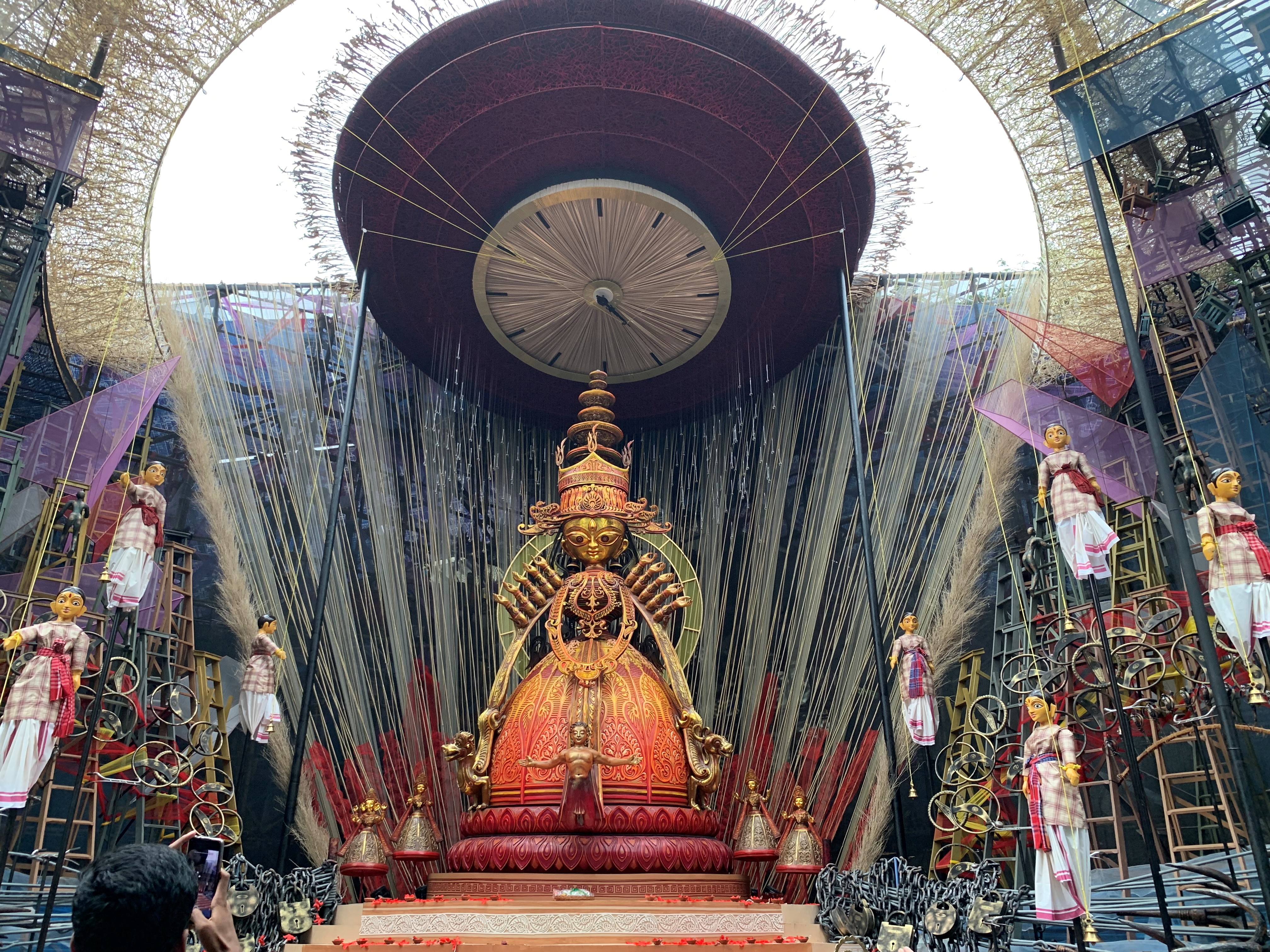
At Tridhara Sammilani, the organisers showcased the unending ‘Daur’ of the common man in the rigmarole of everyday life. The pandal is made of anchors, chains, cycle wheels and other materials of everyday use and have also made use of lots of puppets denoting the helplessness of the common man. 


Dum Dum Bharat Chakra

At Dum Dum Bharat Chakra the devotees could see the lives of a Baul and a soothing song of Parvathy Baul kept playing in the background whose essence was antarlin or the need to introspect rather than be critical.

Alipore Sarbojanin

At Alipore Sarbojanin, the theme was Chaabi or Key. Now with the pandemic fear gone, people have found the keys to freedom and are once again living their normal lives. 

33 Palli, Beleghata

At 33 Palli, Beleghata, a huge set was created with the installation of a road roller highlighting the rampant urbanization and concretization of our lives where people are represented as silent spectators.


Vivekananda Road

We could go on and on but must step back lest we go overboard. We are now more than convinced that no place on earth can match the creativity and art of the people in this city and state. As a tribute to the unknown artists, we dared to re-phrase the first few lines of William Blake’s immortal poem.

The Artisan

Pandals and Streets, illuminated bright,
In the urban forests of the Kolkata night;
What immortal hand or eye,
Could put such frames in beautiful symmetry.

In what distant deeps or skies.
Burnt the fire of thine dreamy eyes?
On what wings dare you aspire?
What the hand, dare create such magnificent spire?

Salute to the Unknown and Unseen Master Craftsmen. How we wish we knew who you were, we could have shaken your hands, patted your backs, given you hugs and made you famous by taking your names far and wide. You need to be seen and recognized and given your rightful dues for creating such masterpieces and putting together the world’s biggest street festival.

DS & SS


Sunday, 2 October 2022

Protima- A Photo Essay

We, finally, landed in Kolkata for the Durga Puja after fourteen long years. We were well aware of the frenzy the city gets into during the actual Puja days from Shashti onwards till Vijaya Dashami, so we planned our arrival three days in advance. In the first four days, we criss-crossed the city from North to South, East to West and visited about sixty-five major pandals and were completely bedazzled by the artistry, the imagination and the wide variety of idols and pandals created by the artists and artisans. Not one of the idols or pandals were similar, each one was unique and some of the creations like St. Peter’s Basilica at the Vatican and the Meenakshi Temple at Madurai were made keeping the smallest of details in mind by people who had possibly never seen the real iconic places and relied on pictures and other visual materials shared with them. We travelled extensively during the day for we knew how Calcuttans love crowding the roads at night and we wanted to avoid being trampled beneath the feet of the believers. At night the city gets resplendent with colourful illumination, not only in the pandals, but on every nook and corner including streets, by-lanes, buildings and flyovers lending a brilliance to this magnificent festival which has found a place on the UNESCO’s Representative List of the Intangible Cultural Heritage of Humanity.

UNESCO in its citation wrote, “Durga Puja is seen as the best instance of the public performance of religion and art, and is a thriving ground for collaborative artists and designers. During the event, the divides of class, religion and ethnicities collapse as crowds of spectators walk around to admire the installations.” It is the first Asian festival to receive the prestigious recognition.

In Bengal, it is believed that Goddess Durga comes to her parental home on earth from Kailash every year with her four children- Ganesha, Kartik, Lakshmi and Saraswati. She comes for four days and returns on the fifth and that is the day of Visarjan when the idols are immersed in the holy rivers. Since this festival celebrates the Goddess’ homecoming, there is a religious part to it and the Mother Goddess is worshipped following all the rituals at homes and in community pujas. It is also a festival which is associated with homecoming and seen as a joyous occasion which involves family reunions, sharing, giving and celebrating life.

In this first part of blog on Kolkata’s Durga Puja, we shall share some photographs of the best protimas of Goddess Durga. It was difficult for us not to share all the beautiful idols but due to paucity of space we first thought we would put in just 10 but finally came down to many more. In the next blogs we will try to capture the magic of the theme pandals, the play of light and sound, the pet pujo and much more. Through these idols or protimas of the Goddess, the artists are able to bring to the devotees the various forms the Mother Goddess is worshipped- as the mother, a symbol of womanhood, the harbinger of peace, as the ferocious Mahishasur Mardini who vanquishes the demon king. She rides a lion and is mostly seen as a ten-armed goddess with Trishul, Sword, Conch Shell, Sudarshan Chakra, Lotus, Bow and Arrow, Mace, Axe, Thunderbolt and Snake- each one of them given by the various Gods who created her to get the world rid of the menace of the demon king, Mahishasur, who had a boon that no man or animal would ever kill him.

Tridhara Sammilani

Chetla Agrani

Kashi Bose Street


Ekdalia Evergreen

Beleghata 33 Pally

Golaghat

Ahiritola

Kumartuli

Dum Dum Park Jubakbrinda

Dum Dum Bharat Chakra

AE Block, Salt Lake

Mitali, Kankurgachi

95 Pally, Jodhpur Park

66 Pally, Chetla

Maddox Square

Behala Nutan Dal

College Square

Last Words

If there is any place you should be during Durga Puja, it is here in Kolkata. At least once in your lifetime you must experience it. The otherwise old, lethargic and, in parts, even dilapidated city turns into the biggest canvas on earth painted by great masters in all colours, styles and vibrance. The microphones churning out the most beautiful of old melodies, the sound of the dhaak beats , the aroma and smoke emanating from the incense burning in the dhunuchi, the jam-packed roads with people dressed in their finest attire, yummy street food all around and rows and rows of colourful and hi-tech illumination …surely along with Ma Durga, paradise moves into this city for five unending days.  

DS & SS

*NB: Pictures by DS & SS